A company does not trust data because it sits in a governed platform. It trusts data when people can find it, understand it, verify where it came from, determine whether it is fit for purpose, and know who is accountable when it fails.
I first worked with this distinction properly at the National Research Foundation, where I helped develop a certified open data platform. Certification meant the platform had to demonstrate, to an external standard, that its data was not just accurate but usable, verifiable and accountable over time. That work was built on two frameworks: FAIR and TRUST. Both were developed for scientific data stewardship and digital repositories, but the questions they force you to answer are exactly the questions a business needs to answer before it trusts a dataset. I have carried them into commercial data science ever since.
Data quality is not the same as data trust
A dataset can contain accurate values and still be unusable. Nobody knows where it came from. Different teams define the same metric differently. Access depends on asking one particular employee. Transformations are undocumented. The data is stale. There is no accountable owner. The pipeline could disappear when a contractor leaves.
Data quality describes characteristics of the data itself. Data governance defines the decision rights, responsibilities, standards and controls through which data is managed. Trust is the outcome when those mechanisms work consistently, and it is the thing that actually determines whether people use what you have built.
FAIR, translated into commercial practice
FAIR stands for Findable, Accessible, Interoperable and Reusable. It was designed for both human and machine use of data.
| Principle | Commercial interpretation | Practical evidence |
|---|---|---|
| Findable | Employees can locate the correct data product | Searchable catalogue, clear names, business definitions |
| Accessible | Authorised users can obtain it through a defined process | Role-based access, documented APIs, service expectations |
| Interoperable | Data can be combined across systems | Standard identifiers, schemas, units and taxonomies |
| Reusable | Someone can safely use it beyond its original project | Lineage, metadata, quality thresholds and usage constraints |
A point worth making explicitly: FAIR does not mean all data must be open to everyone. Accessible can still involve authentication, authorisation and privacy controls. The principle is about a clearly defined access mechanism, not unrestricted access.
TRUST, translated into commercial stewardship
TRUST stands for Transparency, Responsibility, User focus, Sustainability and Technology, and it focuses on whether a repository, or in a business context a data platform, can be relied on over time.
| Principle | Commercial interpretation |
|---|---|
| Transparency | Disclose sources, transformations, limitations and known defects |
| Responsibility | Assign named Data Owners, Data Stewards and, increasingly, Data Product Managers who are accountable for definitions and quality |
| User focus | Design data products around actual business decisions |
| Sustainability | Fund maintenance, not only initial development |
| Technology | Use infrastructure that supports security, lineage, monitoring and recovery |
This adds a dimension FAIR alone does not fully cover. An excellent dataset has limited value if the organisation cannot maintain the pipeline, explain it, or support the people using it. That was the hardest part of certification at the NRF, and it is the part most commercial data teams underinvest in.
Applying both to a real commercial problem
Take a customer churn or booking-cancellation model.
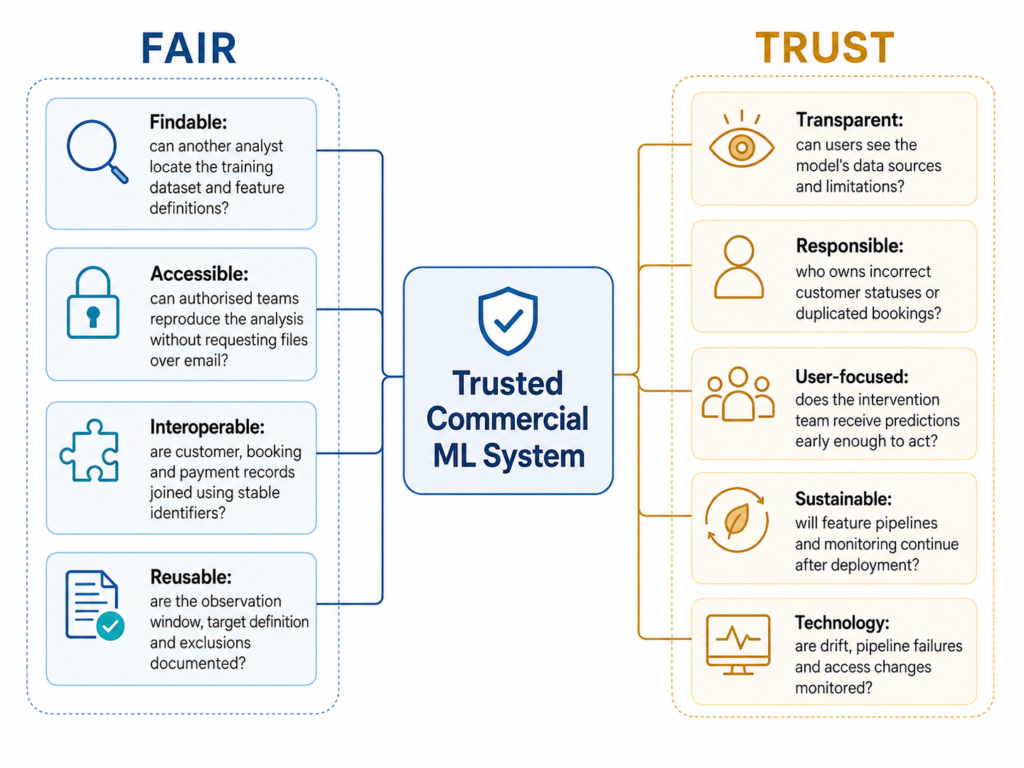
Trust here is not an abstract ethical quality. It directly affects model performance, operational adoption and financial outcomes.
A practical trust test
A business should not ask only, is this dataset accurate. It should ask:
- Can the right people find it?
- Can they interpret it consistently?
- Can its origin and transformations be verified?
- Is it sufficiently current, complete and valid for this decision?
- Are its permitted and prohibited uses clear?
- Is someone accountable for it?
- Will it remain available and maintained?
- Can errors be detected, communicated and corrected?
The caveat
FAIR and TRUST are not complete commercial data-governance frameworks on their own. They do not fully specify privacy compliance, security controls, retention rules, master-data management, decision rights or regulatory accountability. They work best as a trust-oriented design lens layered onto an organisation’s existing governance and data-quality controls, the same role they played in certifying the NRF platform, just applied here to commercial decisions instead of scientific repositories.
For South African businesses, that regulatory backbone is the Protection of Personal Information Act. POPIA sets eight conditions for lawful processing, including accountability, openness and information quality, that map closely onto the trust questions above but carry legal force. An organisation can satisfy every FAIR and TRUST principle and still break POPIA if it cannot show a lawful basis for processing, a registered Information Officer, or a documented response to a data subject’s access or deletion request. The two are complementary rather than competing: FAIR and TRUST tell you whether data is usable and reliable, POPIA tells you whether you were entitled to hold and use it in the first place.
Trusted data is not data without errors. It is data whose meaning, origin, quality, limitations and ownership are visible enough for people to make informed decisions about whether to use it.